In this short interview, Kellynn Wee talks to ASEAS about her Research Impact Award-funded tabletop roleplaying game, Move Quietly and Tend Things, its role in inspiring reflections and practices around environmental issues, and whether TTRPGs should be a part of university teaching.
Please introduce us to Move Quietly and Tend Things and what inspired you to create the game?
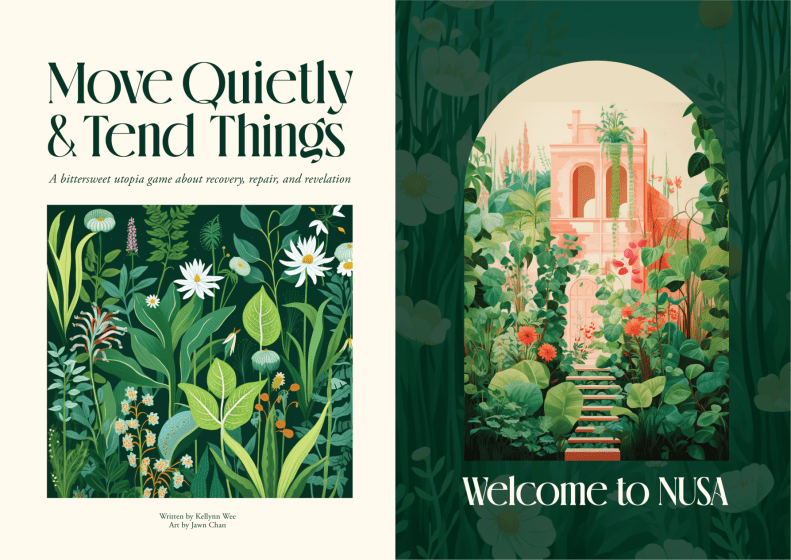
KW: Move Quietly and Tend Things is a collaborative storytelling game. Unlike other games, there is no “end” goal or way to win; rather, players sit together at a table, open up a PDF or a book, and follow its instructions to collectively create a world and tell a story about characters set in that world. Players can pick from five different roles—the Archivist, the Elder, the Repairer, the Gardener, and the Stranger—all of whom have different motivations, interests, and personalities. They ask each other questions to develop character relationships, draw cards to respond to world-building prompts, and sketch together on a shared map to tell a story.
The game is set in a speculative future Southeast Asia/Singapore where you are a small community living on a derelict skyscraper. Some of the questions the game asks include inviting people to invent a rice-based dish for a yearly competition, to imagine the taste of honey – as bees no longer exist – or to create a name and appearance for a nomad community briefly visiting on a passing blimp.
I created this game because I was tired of dystopic climate futures. Looking into utopic imaginaries, however, I also found myself shying away from tech optimism and this perspective of Singapore as a solarpunk haven, when in reality Singapore is an authoritarian nation-state complicit in the unfair redistribution of climate costs within the Southeast Asian region.
I ended up calling the game that emerged a “bittersweet utopia”. I wanted to make a game in which people could fall in love with something beautiful, something that celebrated all my favourite parts of home – its sounds, smells, tastes, and textures. But I also wanted to mourn its loss as a sort of museum of the future, to come to terms with the weight of complicity and responsibility. In a way it’s an exploration of my own tangled feelings of climate grief, culpability, hope, and despair. But my inspiration behind this game and the intent behind it could be very different from how it’s perceived and played!
Why use a tabletop roleplaying game to communicate research?
KW: A TTRPG is a really interesting form, I think, because of its general rejection of “win” conditions or of any clear objective. Many TTRPGs are made as a way for people to tell stories together, to create shared fictional memories, to evoke a mood or a sensation or a feeling – and because it is participatory, people are not simply witnessing or consuming or responding but are actively making. I think about a TTRPG as an open question or an invitation rather than an argument; to make a game is to relinquish the story to others, to ask others to engage in the act of crafting.
In using a game, I was curious about a praxis of knowledge production that extends beyond an arrangement in which a scholar is positioned as an authority who “makes” knowledge for others to receive. I don’t think that the TTRPG is necessarily the only form that does this; nor do I think that this positioning of the scholar is inherently wrong. But I do think that there’s something lovely and useful and curiosity-provoking about making a thing that draws people together into creative conversation for a few hours.
Do these games have a part to play in inspiring reflections and practices around environmental issues?
KW: To be honest, I’m not sure. The flexibility of the TTRPG form means that it’s often shaped by things beyond the game – the social dynamics of the group playing it, the group’s shared cultural referents, the group’s desire at the point of play, how the game has been contextualised, the space and time in which it is being played. I wanted to veer away from being didactic about what the game could do; my only hope was for people to create a memory together about something that hasn’t yet come to pass – an odd folding of time where you remember the future with a tinge of sadness – and for people to share this memory with each other. Does this inspire environmental change, necessarily? Again, I can’t be sure.
However, what I do know is that games can bring people together. To play is to open up the possibility of both transformation and possibility. My favourite part about games is the way that it has the potential to upend and transform dynamics within small-group settings. For example, one of my favourite memories of this game is playing it at an interdisciplinary climate change conference. I think it offered an opportunity for strangers to come together in a different way than the presenter-audience dynamic, in some way to muddle pre-existing relations. I think that might be the true strength of games like these.
Should they be a component of university or even classroom teaching?
KW: Yes, I think so! I’ve invited people to play Move Quietly and Tend Things in digital anthropology courses and also brought in TTRPGs into multimodal method modules where I asked students to “hack” or remix a game to reflect their experiences of educational violence. I thought both of these experiences were quite illuminating, and students seemed to find them interesting and thought-provoking.
Games can be very explicit constructs when it comes to a) frames of action – what can be done and b) values – what actions the game rewards. To take a simple example, when you play Super Mario, you’re rewarded for jumping – so your primary action is jumping. You learn to time your jumps, to anticipate enemies that you can jump on, to check your score as a measure of your success. Move Quietly and Tend Things rewards players for interacting with each other’s creations by giving them new and interesting objects for doing so. This is a frame which suggests that reciprocity and attention are valued within the game. Other games may suggest that violence is a player’s primary mode of action – its mechanics may only allow players to approach the world through combat. This could have all kinds of implications around how violence is conceived of by the game designer.
To think about what frames constrain or enable our actions and how we are asked to act within them is a useful activity and is a key part of critical thinking. The added bonus of TTRPGs is that the frames themselves are changeable; it’s very common, when playing storytelling games, to collectively shift the rules to suit the table, whether this might range from something as simple as avoiding content around body horror to suit a player’s preferences or to making singular exceptions on a case-by-case basis in pursuit of a good story. So, yes, I do think that games could be incorporated into education and teaching in lots of interesting ways!
You’ve done a lot of playtesting internationally to develop this game. How was that experience and how did the feedback inform the game’s evolution?
KW: I learned that playtesting is absolutely invaluable! I didn’t expect that I needed so much structure for a game to work: I’m not a person who likes to make declarations about things, but I realised that for a game to be playable, I needed to make decisions about its rules and stand by them. For people to play freely, I needed to be firm about form. I was very grateful for every playtester who muddled through vague iterations of this game. I received a lot of feedback about the game’s mechanics, which was incredibly constructive. What was also very helpful was simply observing how people played the game and seeing how something as implicit as the way an instruction was worded could shift the whole course of the game.
My favourite part was the pleasure of seeing people familiar with Southeast Asia play the game: the joy of recognising an in-joke or a reference, the pleasure of explaining to others what a koel bird sounds like or what a Rafflesia flower is. I was worried that a non-Southeast Asian audience wouldn’t be interested, but I then also had the pleasure of hearing play reports from groups ranging from the UK to Japan. It requires more work for people unfamiliar with its cultural referents, but the text encourages people to Google anything they’re unfamiliar with, and even that small act of permission or encouragement seems to open it up to a wider audience.
Where can we play Move Quietly and Tend Things?
KW: You can find it here for free! It’s a simple PDF file you can download and open on your devices or print out, if you’d like. You’ll also need a deck of cards (you can use a digital deck!) and some stuff to draw on. I’ve observed the game played virtually without any issues as well – Zoom has a collaborative whiteboard, for example, that people use to make maps.
What’s next for you?
KW: My goal this year is to finish my dissertation in one piece! My PhD focuses on play cultures in tabletop roleplaying games in Singapore. I’ll then be working on a project with some wonderful folks in the University of Bonn that develops the idea of play and games as a co-creative method with different communities in Germany. This follows directly from this project – I would never have had that opportunity without this experience, so I’m very grateful for the ASEAS Research Impact Award that made this possible!

 ASEAS
ASEAS 