By Gilang Mahadika

In this blog post 2023/24 ASEAS Master’s Dissertation Prize co-recipient, Gilang Mahadika, tells the story behind their prize-winning dissertation: ‘Gardening in the Plantation: Indigenous Agroforestry System of Smallholders for Balancing Commodity Needs, Subsistence, and Restoring Biodiversity in Borneo’.
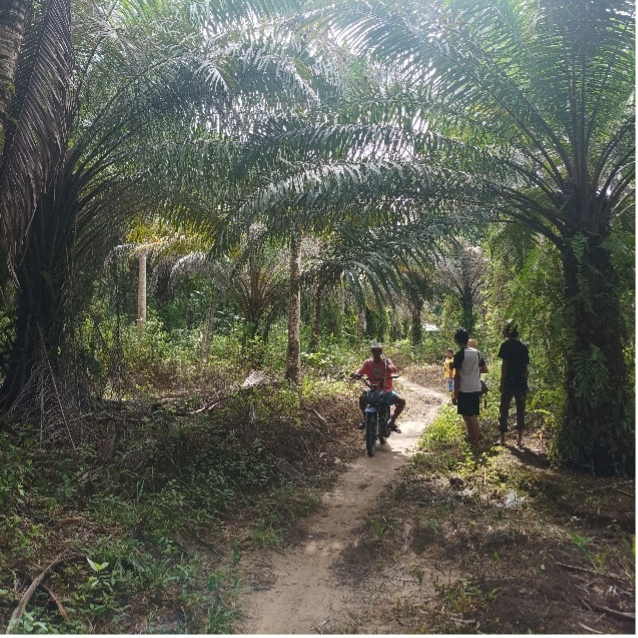
As I walked through the pathways of these patchy lands, mostly owned by the indigenous smallholders, the Dayak Benuaq people, a community living in Kutai Barat, East Kalimantan (East Borneo), I saw massive oil palm monocultures surrounding their homelands. One of the transnational oil palm companies, London Sumatera (Lonsum) has been living with them for more than two decades, contributing to significant changes on the landscape where these indigenous communities live. To that end, oil palm monoculture has been generally known as a problem that is not merely social, but also environmental in Indonesia.
Starting from March 2022, I stayed with the Dayak Benuaq people in order to be able to learn their culture and survival ways living surrounded by the monoculture plantations. Some of the interlocutors guided me to go inside their kebun hutan (forest gardens) locally known as simpukng. These giant gardens have provided the Dayak Benuaq people with a lot of varied materials to fulfill their daily needs, such as woods for material construction, fruit trees and tubers for foods, and some space to make umaq, swidden farming for vegetables and rice.
Meanwhile, Javanese transmigrants living in Kalimantan have also been practicing gardening generally known as pekarangan or kebun-talun (home gardening), in which sometimes their gardens are close to their plantations. I saw that this type of indigenous agroforestry system has become a prominent source of materials for the community’s subsistence to keep them intact in the midst of environmental disruptions.
During my fieldwork, I often encountered many endemic types of macaques, such as Proboscis monkey (Navalis larvatus), Borneoan white-bearded gibbon (Hylobates albibarbis), Müller’s gibbon (Hylobates mueller), and many other primates living in the smallholders’ garden. When the fruit season comes, they often storm into the gardens and start taking any food they can get. I was impressed by these species that also explains how forests in Kalimantan are becoming narrowed from time to time.
Hence, gardening is, to me, a fascinating activity that is culturally embedded within the smallholders’ way of life. Through gardening is used to restore biodiversity in the expansion of monocultures in Indonesia, it also provides a sense of refugia to keep these endemic species alive amidst environmental disturbance. The Anthropocene is an epoch that is marked by putting human’s desire above all of more-than-human species. Oil palm, tea, rubber, and many other monoculture plantations are examples of providing a great impact on the loss of biodiversity. We should learn again how indigenous communities (smallholders) can survive in the lands of monocultures.
I completed my Master’s thesis in January 2023. I would like to give my highest appreciation to BiPoN (Beyond the Domesticated and Wild Divide: Plant Biology and the Politics of Nutrition) at the University of Cologne, Germany (Gilang Mahadika (uni-koeln.de)), which has supported this research along with Prof. Pujo Semedi and Prof. Michaela Haug as my supervisors for this research. I would also like to say thanks to Prof. Setiadi who guided me through my years in the Gadjah Mada University (UGM) to obtain my Master’s degree in Anthropology. Needless to say, I would like to say thanks to the Dayak Benuaq people and Javanese transmigrants who welcomed my presence during my fieldwork in Kalimantan.
Lastly, I thank UGM for the nomination and extend my gratitude to ASEAS (UK) for the recognition and interest in my work.
Find out more about the ASEAS Master’s Dissertation Prize and how to apply.

 ASEAS
ASEAS 