By Fahmi Rizki Fahroji, School of Geographical and Earth Sciences, University of Glasgow
In our latest blog post, recent ASEAS Research Impact Award recipient, Fahmi Rizki Fahroji, shares his thoughts from the field, investigating the overlooked post-mining landscape in South Borneo, Indonesia.
My friends in Balangan, South Kalimantan – coal workers, farmers and indigenous people – lived near the Adaro mines and explained to me over the years that coal extracted from a strip mine is not a barren or dead material. Instead, it is physically and literally imbued with stories.
The Dayak Deah, who have lived here since pre-colonial times, believe that their buried ancestors leave traces underground. From the beginning, the Dayak have identified mineral resources and used them in their daily lives (see Hageman 1855; Sellato 1993; Poley 2013). Project records of the ‘Dutch Natuurkundige Commissie’ in the 19th century at least mention the Dayaks as geologists’ helpers.
“When I was distilling the coal samples, my Dayak helpers asked for the exuding tar and actively collected it. They told me that it was very similar to a type of “minyak tanah” found in the area where they come from: it is used by them as a medicine. […] the presence of oil in this place is evidence of the proximity of coal.”
Dutch geologist C. Shwaner’s excerpt on Poley (2013: 21)
Kalimantan – under the Dutch geologist/naturalist – served as a ‘hunting ground’ for the search for oil and coal. With the application of scientific and technological techniques in later years, some major changes occurred (van Gorsel 2022).
To argue that the futures are contested and materialised, I conducted ethnography and historical analysis to help further situate the discourse of Indonesian origin of mining. While the research provides a general account of life with mining, I will limit this blog to a modest point of inquiry: How did indigenous people living at the boundaries of geological and technological zones anticipate their future with the coal industry?
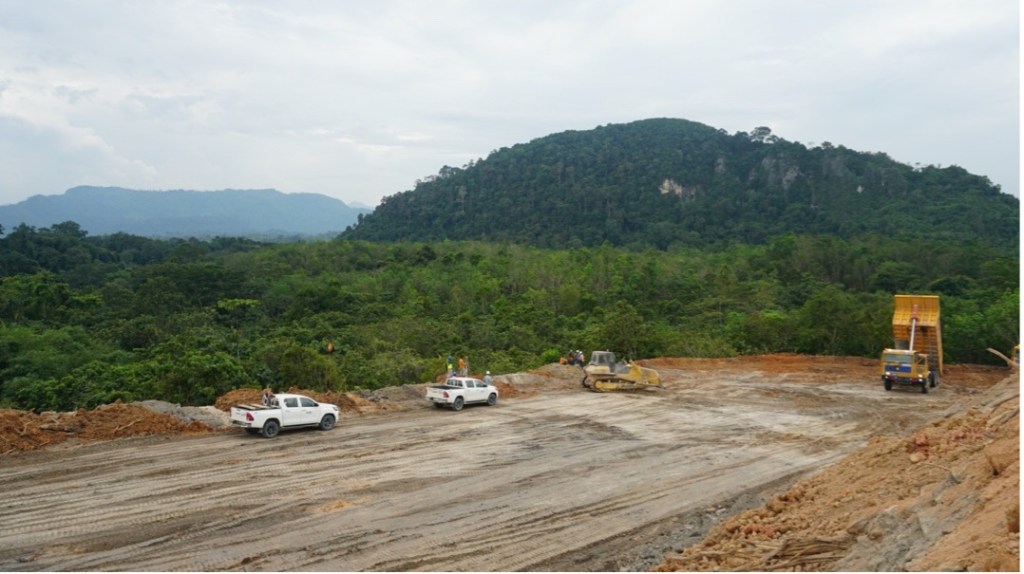
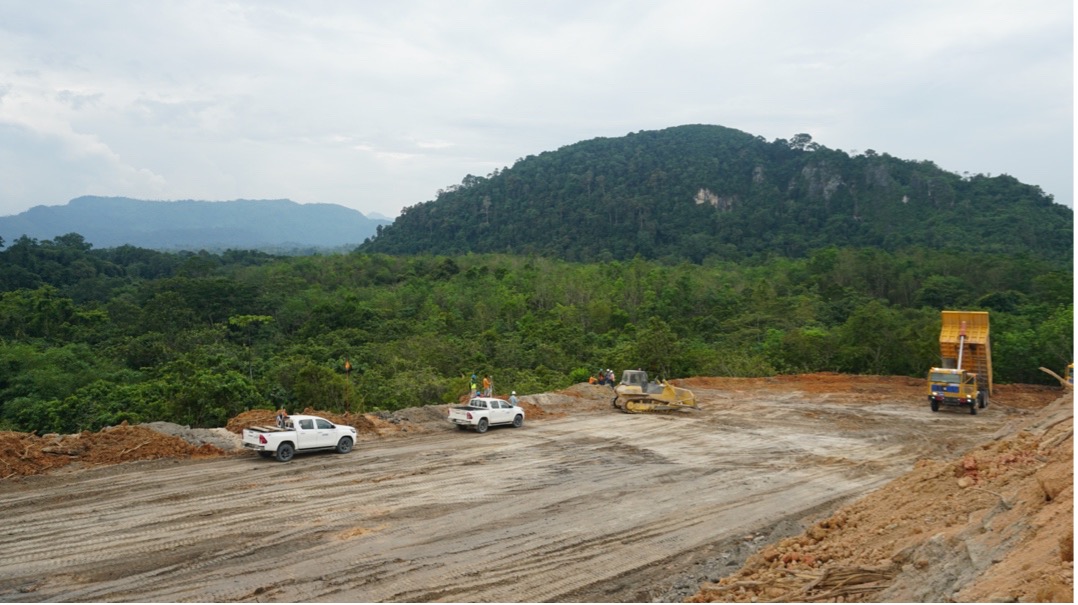
Figure 1. MCM mining equipment operating on cleared land behind Mount Betjalin.
Today, Balangan – some 300 kilometres south-west of the planned capital of the new Indonesia – is home to a major coal mining project operated by PT Adaro Indonesia since the 1990s and a new coal mine, PT Mantimin Coal Mining. For some, these coal companies provide jobs and economic opportunities that help support their families and communities. But this prosperity comes at a cost, as the environmental impacts of mining take their toll on the land and threaten the livelihoods of farmers and indigenous peoples.
In navigating the complex terrain of geological and technological zones, the people of Balangan are forging their own way forward. They are drawing on their cultural heritage and traditional knowledge, while embracing new technologies and innovations that offer hope for a more sustainable future.
During my fieldwork, I realised that the Dayak people have negotiated with the current extractive activities taking place on adat land. For the Dayak villagers I lived with, the presence of mining changed the way they practised shamanism and land-clearing rituals, but not their fundamental importance to a good life.
When PT Mantimin Coal Mining began its exploration in Dayak customary territory, the company had to bring some items as offerings to ask permission and apologies from the Dayak gods who live around the mining area. For example, the day before I arrived in Liyu, the Dayak shaman held a ritual to exorcise the dead or spirits living on Mount Betjalin. The story was that MCM had asked the adat leader to move the ghosts and spirits occupying the mountain because a few weeks ago some workers had had nightmares about seeing the ghosts, terrifying ghosts, in their dreams. ‘Palas Alam’, a traditional event to apologise to nature, the guardians (ancestral spirits) and the gods (according to Dayak belief) and to ask for permission and blessings from the Dayak people, was held the day before my stay.
The Dayak shaman’s involvement here was partly an attempt at spiritual consolidation, but also, it seems to me, to make the company feel that they were in a dangerous place, to show them that they were not working in a place without history or meaning. My ethnography has shown that within fossil capitalism, spirits can be an agency that locates Dayak cosmology within geological forces, nuancing the amodern political geology that deals with the question of the future (Bobbette & Donovan 2019).
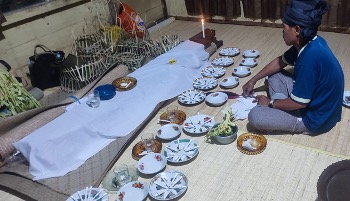
Figure 2. ‘Sesajen’ (offerings) for the spirits who live on Mount Betjalin. The offerings are provided by the adat leader to consolidate with the spirits. It consists of flowers, cigarettes, water, candles, and incense.
Shamanism is a culture that dominates the religious life of the Dayak Deah. Offering sacrifices is not only a way of summoning and enlisting the presence of spiritual beings. In a sense of geological politics, this spiritual being gives a strong nuance of agency that can coexist politically within life under mining zones. In other words, mining can shape agency in contradictory ways – it helps the company to open up new mining zones, but local people also creatively reinterpret mining in line with cultural understandings of the good life (Robbins 2013).
My local counterpart said that mining is not only a machine that requires special and disparate technology, but also a backdrop for the emergence of spirits. What is imperative here is that the Dayaks have begun to display their geological knowledge through spirits, making their identity – following Yusoff’s (2014) argument – part of the ‘geological subject’. However, these spirits and the reparative model of being a patron for an enterprise mediate the future.
In this context, the expansion of the mines, which continue to encroach on indigenous Dayak territory, has allowed an unprecedented influx of capital into the previously inaccessible region over the past few decades. The controversial presence of mining companies has more or less changed the social structure of the indigenous communities. I argue that for fossil capitalists, spirits has become wealth, mediation, and fluidity. While these cosmological reasons have opened up imaginations about the future of life in and around mining areas, whether this will continue under the energy transition regime is a case in point.
I hope that this study can further inform scholarship in political geology, anthropology, and science and technology studies.
Fahmi Rizki Fahroji is a human geographer in training with a focus on ethnography, ecology, politics, and development studies. He is currently working as a Research Assistant at the Centre of Climate and Sustainable Finance (CCSF), University of Indonesia.
Read more about Fahmi’s research in South Borneo.
Find out more about the ASEAS Research Impact Awards and how to apply.

 ASEAS
ASEAS 